An honest practitioner's account of what happens after Odoo Software goes live, from a team that has seen it across manufacturing, distribution, solar, and textile businesses.
Written for business owners who have shortlisted Odoo and want to know what to expect in the first 90 days. You will walk away with a clear framework for avoiding the most common failure patterns after go-live.
Most Odoo Software evaluations focus on the wrong phase. Buyers compare feature lists, sit through demos, negotiate pricing, and sign contracts, all before a single real transaction has run through the system. The comparison that actually matters happens in the weeks after go-live, when the gap between what was configured and what the business actually needs becomes visible.
We have taken over 300 businesses live on Odoo Software across manufacturing, textile, solar, and distribution. The failures we have seen were almost never about the software. They were about what happened, or did not happen, between day 1 and day 90 after switching on.
- →Odoo Software go-live averages 6 to 12 weeks with a structured partner. Traditional ERP takes 6 to 18 months before delivering any operational return.
- →Gartner research shows nearly 70% of ERP initiatives fail to deliver expected business value, not because the software breaks, but because the system falls out of alignment with how the business actually operates.
- →According to Tatvamasi Labs, based on 300+ Odoo go-lives, businesses with a phased module rollout stabilise within 60 days post go-live. Those who activated all modules simultaneously reported data overload and parallel spreadsheet use within the same window.
- →User adoption is the most underprepared phase in both Odoo and traditional ERP. Generic training causes employees to revert to spreadsheets within 60 days.
- →The 30 to 90 day window after go-live is the period that determines long-term success. Businesses with hypercare support stabilise. Those left to manage alone accumulate technical debt.
The Comparison Everyone Makes Before Go-Live (And Why It Misses the Point)
Buyers evaluating Odoo Software vs traditional systems almost always focus on criteria before go-live. These factors are real, but they predict almost nothing about whether the implementation will still be working well in 18 months.
What buyers typically compare:
- →Licence cost and total cost of ownership estimates
- →Feature coverage across modules including sales, inventory, accounting, and HR
- →Vendor reputation and partner ecosystem
- →Implementation timeline promises
What actually determines long-term success:
- →How quickly the system can be changed when the business changes
- →Whether users actually adopt the system or work around it
- →What support actually looks like after go-live, not what is promised in the sales deck
- →Whether the implementation partner is still engaged after the go-live invoice is paid
What Traditional ERP Businesses Experience Post Go-Live
Traditional ERP systems such as SAP Business One, Oracle NetSuite, and Microsoft Dynamics typically require 6 to 18 months of implementation before a business sees any operational return. The picture after go-live is defined by rigidity, high change costs, and deep vendor dependency.
-
✗
Every change requires a vendor ticket. Adjusting a workflow, adding a field, or modifying a report triggers a formal change order, typically billed at consultant day rates.
-
✗
Licence upgrades are not optional. Adding a new module or user often requires a tier upgrade. These are costs that were invisible in the original TCO estimate.
-
✗
Support after go-live runs through a ticket queue and is slow. Non-critical issues such as a dashboard not refreshing or a report pulling incorrect data sit in a queue for days. There is rarely a named account manager after go-live.
-
✗
Scope changes during implementation are expensive. Any deviation from the original specification triggers additional billing. Growing businesses that adjust processes during implementation often face significant cost overruns.
-
✗
Version upgrades are major projects. Major version upgrades on traditional ERP typically require 3 to 6 months of reimplementation work. Many businesses stay on outdated versions for years as a result.
For a detailed account of the patterns that emerge when a system is too rigid to accommodate business growth, see our post on why Odoo Software implementations fail.
What Odoo Software Businesses Experience Post Go-Live
Odoo Software implementation is faster and more flexible, but the picture after go-live is not without friction. The honest account includes both the genuine advantages and the surprises that catch businesses off guard.
What goes right
- ✓Go-live in 6 to 12 weeks with a structured implementation partner
- ✓Configuration changes without touching core codebase
- ✓Modular rollout to add functionality as the business scales
- ✓Scope adjustments manageable when rollout is phased
- ✓Partner-led customisation without central vendor lock-in
What catches businesses off guard
- !Module compatibility with third party tools breaks during version upgrades
- !Customisation maintenance costs across new Odoo versions
- !Support gaps when no annual maintenance contract is in place
- !Data overload when all modules are activated simultaneously
- !Reporting errors when live transaction volume replaces UAT data
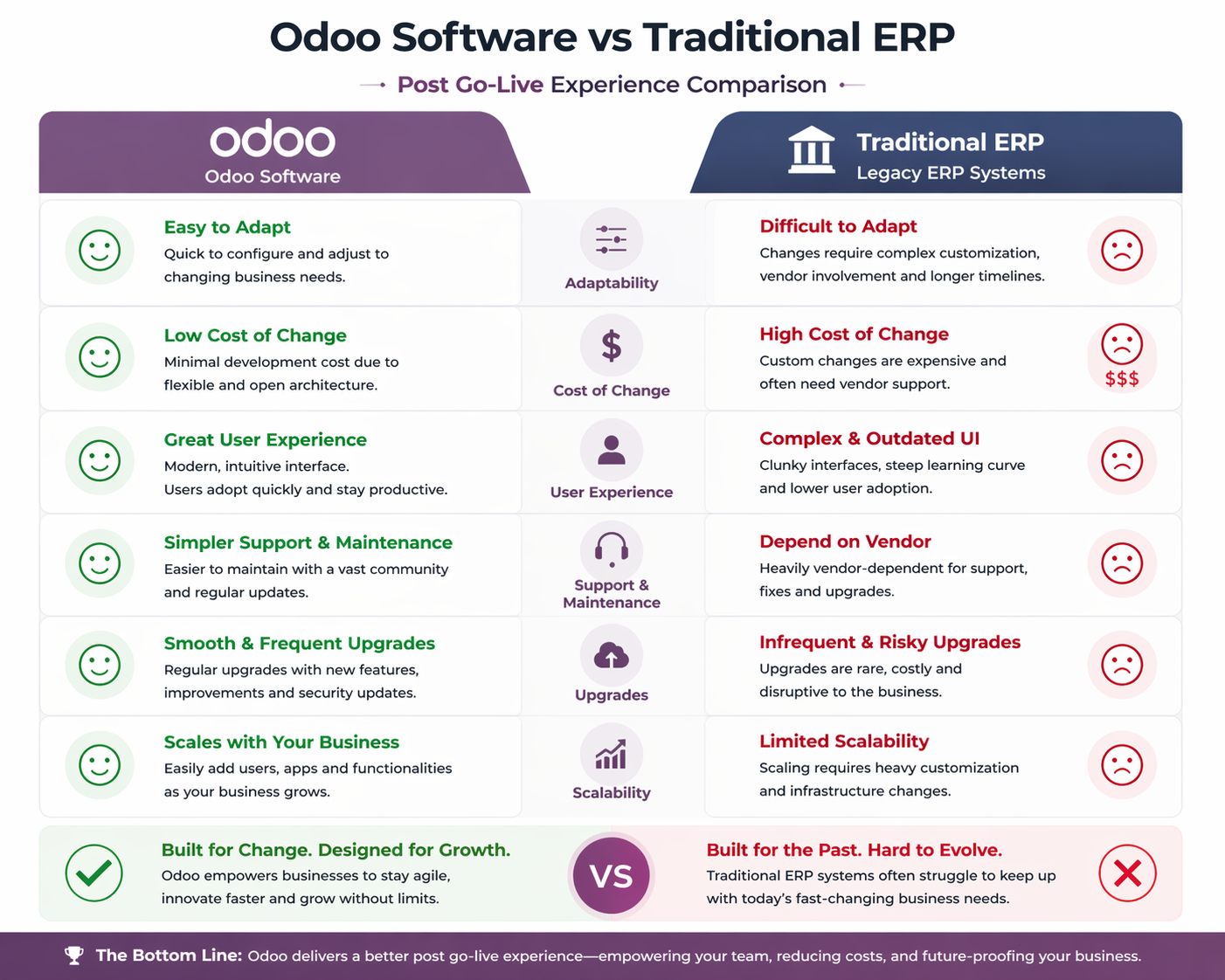
Traditional ERP vs Odoo Software showing the post go-live gap in practice
The User Adoption Gap and the Problem Nobody Warns You About
User adoption is the most underprepared phase in both Odoo and traditional ERP implementations. Neither vendor nor partner typically flags it as the primary risk. Employees end up reverting to spreadsheets within 60 days, and the ERP becomes a parallel system rather than the single source of truth.
User adoption fails when training is generic rather than tailored to each role. A warehouse operator needs different training than an accounts manager, even on the same Odoo Software instance. Generic sessions produce users who know the system exists but not how it applies to their actual daily tasks.
Warning signs of adoption failure in the first 60 days:
- ✗Sales team logging orders in WhatsApp or email instead of Odoo
- ✗Inventory counts maintained in a parallel spreadsheet because "Odoo is slow"
- ✗Finance team bypassing Odoo for month-end because reports "don't match"
- ✗Senior managers printing Odoo screens and annotating them manually
What actually drives adoption:
- ✓Training tailored to each role, where every department learns their own workflow and not the whole system
- ✓A named internal champion in each department who handles daily queries
- ✓Removing the parallel spreadsheet at go-live with no soft transition
- ✓Hypercare support in the first 30 days so users get real answers, not ticket numbers
Our Odoo implementation guide for Indian businesses covers how to structure the training phase as a distinct project workstream rather than a half day session squeezed into the final week before go-live.
Configuration Drift and When the System No Longer Fits Your Business
Configuration drift is the leading cause of ERP failure between 12 and 24 months after go-live. The system was built to match your business at implementation time. But the business has changed with new products, new warehouse locations, and new sales channels, and the system has not kept pace.
Gartner's research consistently shows nearly 70% of ERP initiatives fail to deliver expected business value over time. The cause is almost never a software defect. It is misalignment between a static system configuration and a dynamic business.
⚠️ Common drift scenario A sales workflow built for a business selling 50 SKUs breaks down once that business adds 200 SKUs and a second warehouse. The Odoo Software configuration was never designed for that scale. Nobody flagged it as a future requirement during the original implementation.
How configuration drift shows up in practice:
- →Reports that worked in UAT produce incorrect output under live transaction volume
- →Approval workflows that no longer match the actual authority structure
- →Pricing rules and tax codes that no longer reflect the current sales model
- →Odoo modules that were not designed to interconnect as new ones were added later
With traditional ERP, fixing drift is expensive because every change is a change order. With Odoo Software, drift is fixable without core system edits, but only if a partner with an active maintenance relationship knows the original configuration. A reactive fix from an unfamiliar vendor who has to reverse engineer your setup costs far more than ongoing maintenance would have.
Hidden Costs That Appear After Go-Live in Both Systems
TCO figures shared during ERP evaluation rarely include costs that appear after go-live. Both Odoo Software and traditional ERP carry hidden costs but their nature is different. Understanding where each system surprises businesses changes how you evaluate them.
← Scroll to see all columns →
| Cost Type | Traditional ERP | Odoo Software |
|---|---|---|
| Every system change | Vendor ticket + change order | Partner-led, no core edit needed |
| Adding a module or user | Licence tier upgrade | Per-user Enterprise pricing |
| Version upgrade | Multi-month reimplementation | Third-party modules may break |
| Support after go-live | Ticket queue, slow SLA | Gap without AMC in place |
| Customisation maintenance | Vendor-locked, expensive | Required across Odoo versions |
| Report fixes after go-live | Billable consultant time | Partner-led, faster resolution |
The Odoo Software cost advantage after go-live is real, but it requires an active support relationship with your implementation partner. Without one, you pay premium reactive rates every time something breaks. A structured Odoo ERP support audit after go-live helps identify gaps before they become expensive emergencies.
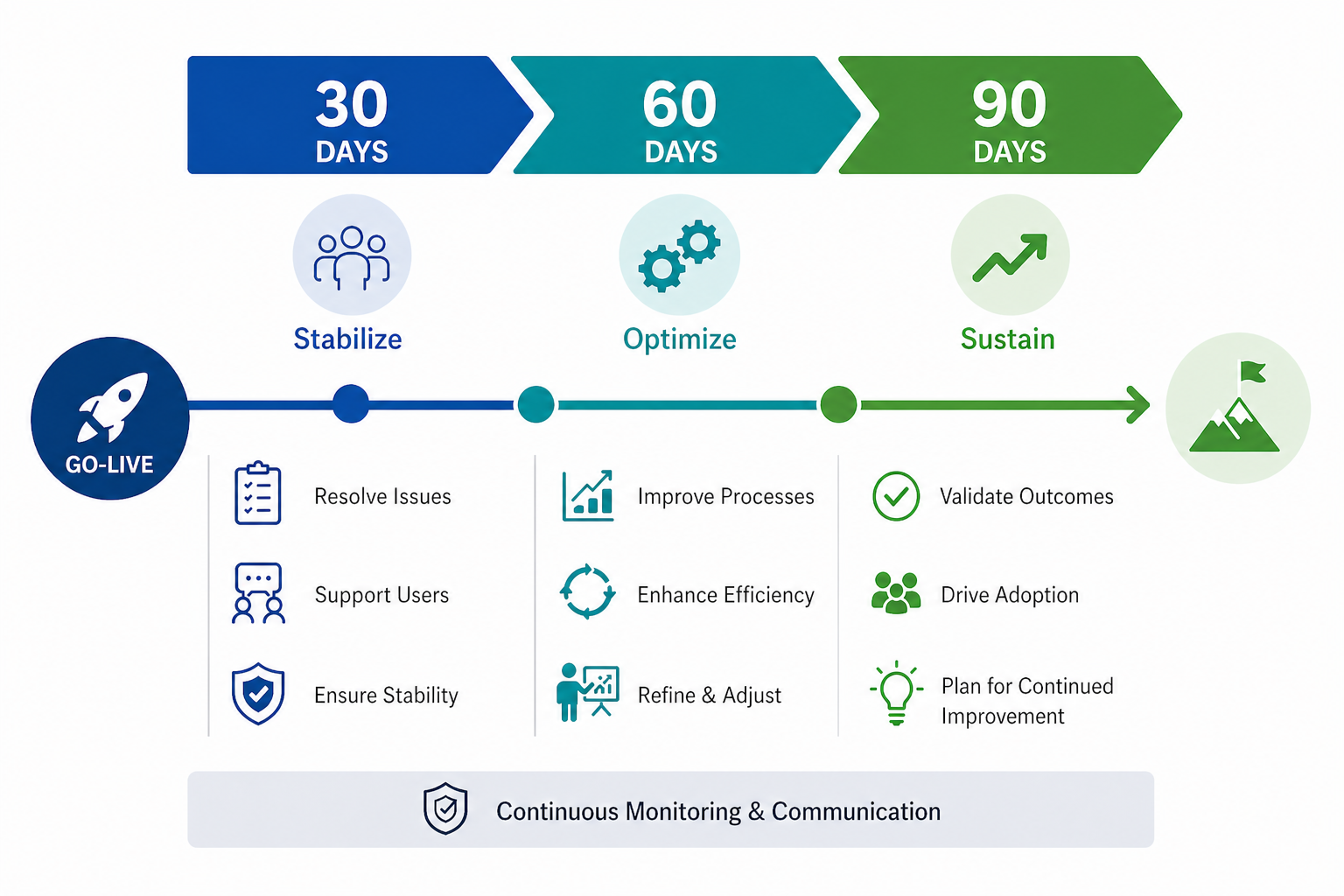
The 30 to 90 day window after Odoo go-live when growing businesses either stabilise or stall
The 30 to 90 Day Window That Determines Success or Failure
Most ERP systems do not fail at go-live. They fail between 12 and 24 months later, but the seeds of failure are planted in the first 90 days. This is when the gap between the configured system and real operations becomes visible. Businesses that close that gap immediately stabilise. Those that leave it accumulate debt.
What the first 30 days reveal:
- →Financial dashboards built in UAT produce errors when live invoice volumes run through them
- →Inventory reports are the most common early failure point, particularly with multiple warehouses
- →User access permissions need adjustment once real roles are applied to real transactions
- →Integration points such as payment gateways, shipping APIs, and external tools reveal edge cases not captured in testing
What separates implementations that stabilise from those that deteriorate:
-
✓
A dedicated hypercare plan This means an active engagement beyond just saying support is available where the implementation team reviews live issues weekly for the first 90 days.
-
✓
A phased module rollout designed from day one Businesses that went live on core modules first, covering sales, inventory, and accounts, and expanded later had significantly fewer crises after go-live than those who activated everything simultaneously.
-
✓
The original implementation partner still engaged Not a vendor who considers go-live the end of the project. The team that built your system is fastest to fix it because they already know where to look.
If you are already live and facing issues in this window, an Odoo consultation focused on stabilisation after go-live is a faster route to resolution than opening a generic support ticket.
What Growing Businesses Actually Need from Odoo Software and When a Certified Partner Changes the Outcome
Odoo Software for growing businesses delivers its full value only when implementation is treated as a 12-month engagement rather than a project that ends at go-live. The software is capable. The question is whether the implementation structure supports what happens after it is switched on.
At Tatvamasi Labs, we are a certified Odoo Silver Partner based in Ahmedabad. Over 300 go-lives across manufacturing, textile, solar, distribution, and eCommerce businesses have shaped how we structure implementations and, more importantly, how we approach the 90 days after.
What we build into every Odoo Software implementation from day one:
-
→
Phased rollout design with future scope mapped We scope future modules at implementation time, even when they will not be activated for 6 months. The data model is built for where the business is going, not just where it is today.
-
→
Tailored role training before go-live Every department gets a session built around their specific workflow in the configured system rather than a generic walkthrough of Odoo features.
-
→
90 day hypercare as standard Support after go-live is not a separate product. The team that configured your system stays engaged and available for the first 90 days, not a ticket queue.
-
→
Annual maintenance contracts with named engineers A named engineer who knows your Odoo instance responds within defined SLAs. The alternative is premium reactive rates every time something breaks after an upgrade.
Our average deployment time is 6 weeks for a structured go-live, because our preparation before implementation is thorough enough that UAT does not surface surprises. If your current implementation has stalled, or you are evaluating Odoo Software for the first time, you can hire a dedicated Odoo developer from our team or engage us for a full project review.
Planning an Odoo implementation or reviewing one that has stalled?
Talk to a certified partner who has taken 300+ businesses live. We consult before we configure and stay engaged after go-live.
Frequently Asked Questions
Prefer a quick chat? WhatsApp our team and we will respond within the hour.
💬 Chat on WhatsApp