
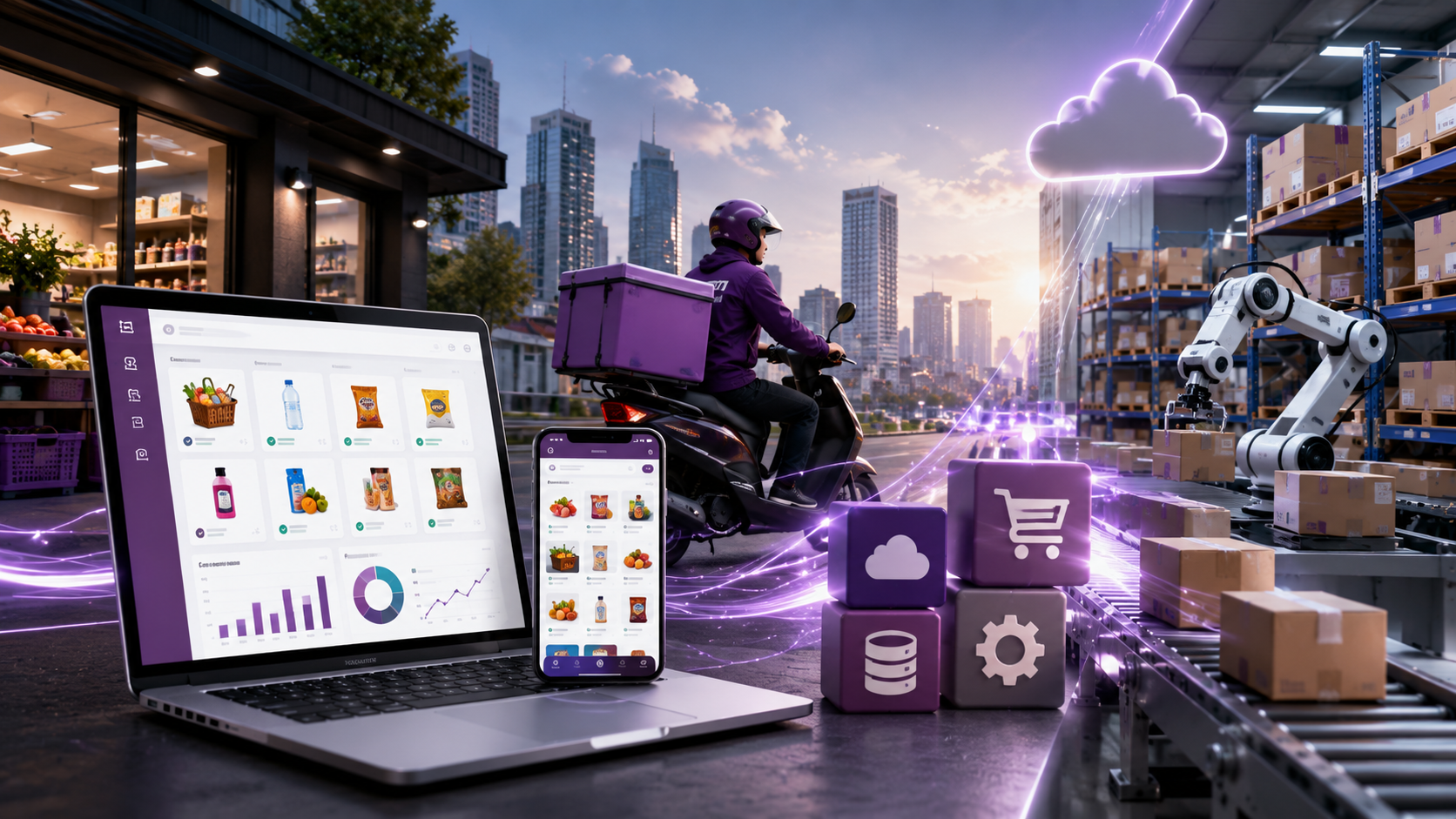
Case Study

From Odoo v14 Chaos to v18 Clarity — A Qatar Quick Commerce Transformation

Client Profile

Leading Quick Commerce Retailer

IndustryQuick Commerce & E-commerce Retail
LocationDoha, Qatar
Physical Stores6+ retail locations across Doha
ChannelsIn-store, own e-commerce platform, Talabat, Snoonu
Product FocusOrganic, eco-conscious groceries & lifestyle products
Project TypeOdoo v14 → v18 migration, database rebuild, integrations
PlatformOdoo v18, custom hosted, optimised

This Doha-based quick commerce retailer has built a loyal customer base across Qatar by combining physical store convenience with fast digital delivery, across their own platform and third-party delivery apps. With 6+ locations and a growing omnichannel operation, they were one of Qatar's most recognisable organic and eco-conscious grocery brands.

But their Odoo v14 instance had become a liability. Years of adding 20+ third-party apps from different vendors had created a fragile, slow, and increasingly unmaintainable system. Data was inconsistent, the database was bloated, and every new customisation risked breaking something else. The platform was holding the business back rather than enabling it.

The decision was made to do it right, committing to a full migration to Odoo v18, with a clean database, removed app debt, custom-built integrations, and proper hosting. The result was transformational.

20+
Apps Removed & Replaced
Platform Speed Improvement
6+
Stores on One Platform
100%
Data Integrity Restored
Live
E-commerce API Integration
The Starting Point

What Odoo v14 Had Become vs. What v18 Delivers

This wasn't a simple version upgrade. It was a complete rebuild, with every problem from the old system addressed by design in the new one.

❌  Odoo v14, The Problem
🔴20+ third-party apps from different vendors, conflicting, overlapping, unmaintained
🔴Bloated, inconsistent database, years of dirty data, duplicate records, broken relationships
🔴Slow platform, page load times degrading, impacting operations across all stores
🔴E-commerce platform disconnected, manual sync, order errors, inventory mismatches
🔴6+ stores managed with workarounds, no clean multi-store architecture
🔴Every upgrade attempt blocked by app dependency conflicts
✅  Odoo v18, The Solution
🟢All third-party apps replaced with native v18 features or custom-built modules
🟢Clean, structured database, rebuilt with proper data architecture and integrity
🟢3× faster platform, optimised hosting, clean codebase, no bloat
🟢Custom API integration, real-time sync between Odoo and e-commerce platform
🟢All 6+ stores natively managed, inventory, POS, and reporting per location
🟢Future-proof architecture, upgrades and customisations no longer blocked
The Challenge

What 20+ Unmanaged Apps Actually Do to an Odoo Instance

Third-party app accumulation is one of the most common and most damaging patterns in Odoo deployments, and this case is a textbook example of why.

App Debt
20+ apps from 20+ vendors, no single owner
Over years of operation, every new requirement was solved by installing another third-party app. Some were abandoned by their developers. Some conflicted with each other. Some had been customised locally, making them impossible to update. The system had become a patchwork that nobody fully understood.
Performance
System speed had become a daily operational problem
With a bloated database and conflicting app logic running on every transaction, page load times had slowed significantly. In a quick commerce operation where speed is the product promise, a slow backend was impacting order processing, stock updates, and staff productivity across all 6 stores.
Data Integrity
Years of dirty data, duplicates, broken records, inconsistencies
Multiple apps writing to the same data objects without coordination had created a database full of duplicate customer records, inconsistent product data, and broken relationships between orders and inventory. Reports were unreliable. Stock counts didn't reconcile. Finance records had gaps.
E-commerce
E-commerce platform running on manual sync
The external e-commerce platform, handling online orders, product listings, and delivery, was not properly integrated with Odoo. Stock updates were manual or delayed, causing overselling. Order data had to be re-entered. Pricing discrepancies between online and in-store were a recurring customer issue.
Multi-Store
6+ stores with no clean unified management
Each physical store's POS, inventory, and sales data was managed with workarounds rather than a proper multi-location architecture. Inter-store stock transfers, consolidated reporting, and per-location performance visibility were all painful manual exercises.
Migration Risk
Upgrading was blocked by dependency complexity
Every attempt to upgrade or even update the system had been blocked by the tangle of third-party app dependencies. Some apps had no v15, v16, or v17 equivalent. Others had custom patches applied that would break on upgrade. The system was effectively frozen in v14 indefinitely, until a full rebuild was committed to.
The Solution

A Full Odoo v18 Migration, Done Right, Not Just Done Fast

The migration wasn't just a version upgrade. It was a complete rethink of how the platform was structured, with every decision made with long-term maintainability in mind.

🧹
App Audit and Elimination, 20+ Apps, Zero Survivors
The project began with a comprehensive audit of every installed app, its purpose, its usage, its last update, and whether Odoo v18's native capabilities had made it redundant. The outcome: the vast majority of third-party apps were completely removed, with their functionality either replaced by Odoo v18 native features or rebuilt as clean custom modules with proper documentation and no external dependencies. What had been 20+ unmanaged apps became a lean, purposeful platform that a developer can fully understand.
🗄️
Database Rebuild, Clean Structure, Reliable Data
The database migration was not a straight lift and shift. Every data object was audited, customers, products, orders, inventory, and financial records. Duplicate records were merged, broken relationships were repaired, and orphaned data was resolved. The data model was restructured to align with Odoo v18's architecture. The result was a clean, consistent database where reports reconcile, stock counts match reality, and finance records are audit-ready. The team can trust their data for the first time.
Optimised Hosting, 3× Faster Platform
The previous hosting setup had been configured for a simpler, smaller Odoo instance and had never been optimised as the system grew. As part of the v18 migration, the infrastructure was rebuilt, with proper server sizing, database query optimisation, caching configuration, and CDN setup for the Qatar region. The combination of a clean codebase and a properly configured hosting environment delivered a platform that runs approximately three times faster than the previous instance, measurable in page load times and transaction processing speed.
🔗
Custom API Integration, E-commerce Platform in Real Time
The external e-commerce platform integration was rebuilt from scratch as a custom bidirectional API. Product listings, prices, and stock levels sync from Odoo to the e-commerce platform in real time. Online orders flow automatically into Odoo as confirmed sales orders, with no manual re-entry and no delays. The integration handles the complexity of a quick commerce operation: multiple fulfilment locations, real-time stock reservation, and order status updates back to the customer-facing platform. Overselling is eliminated. The online and in-store experience are now powered by the same live inventory.
🏪
Multi-Store Architecture, All 6+ Locations, One Platform
All physical retail locations are now properly configured in Odoo v18's multi-company and multi-warehouse architecture. Each store has its own POS terminal, its own stock location, and its own performance reporting, while management sees a consolidated view across all locations. Inter-store stock transfers are system-managed. Per-store sales, inventory, and margin data are available in real time. The per-location visibility that previously required manual spreadsheet compilation is now a standard dashboard.

🔌 Custom Integrations, Built for Qatar's Quick Commerce Ecosystem

Quick commerce in Qatar means being connected to multiple channels simultaneously. The v18 platform was built with a proper API layer that connects Odoo to every channel the business operates, in real time, without manual intervention.

🛒
E-commerce Platform
Real-time product, price, stock and order sync, custom bidirectional API
🏪
6+ Physical Stores
Odoo POS at each location, unified inventory and reporting
🚴
Delivery Platforms
Order feed integration, third-party delivery channel orders into Odoo
💳
Payment Gateways
Qatar-specific payment methods including card, QR, and cash reconciliation
The Results

What the Business Looks Like on the Other Side

"We had been living with the same broken system for years because everyone was afraid to touch it. Every time we tried to fix one thing, something else broke. The migration gave us a platform we actually understand, fast, clean, and connected to everything we need. Our team can process orders, check stock, and reconcile accounts without fighting the system. It feels like a completely different business to operate."
Operations Lead, Quick Commerce Retailer, Doha, Qatar
Performance
Platform Speed
Degraded v14 instance, slow page loads impacting daily ops
3× faster, optimised hosting and clean codebase
App Debt
Third-Party App Dependency
20+ apps from 20+ vendors, fragile, unmaintained, conflicting
Eliminated, replaced by native v18 features and custom modules
E-commerce
Online-to-Odoo Order Flow
Manual sync, delays, overselling, pricing mismatches
Real-time bidirectional API, zero manual intervention
Data Quality
Database Integrity
Duplicate records, broken relationships, unreliable reports
Clean, structured database, reports reconcile, data trusted
Multi-Store
Store Management
Workarounds per location, no unified visibility
6+ stores natively managed, live per-store dashboard
Future Readiness
Platform Maintainability
Frozen in v14, upgrades blocked by dependency tangle
Future-proof v18 architecture, upgrades and growth unblocked
What Was Implemented

Odoo v18 Platform at a Glance

Odoo v18 Core Migration
Full v14 to v18 migration, data, config, customisations rebuilt
Database Rebuild & Cleanup
Deduplication, data repair, structural realignment to v18 schema
Odoo POS, Multi-Store
6+ store POS terminals, unified inventory, per-store reporting
E-commerce API Integration
Custom bidirectional API, products, stock, pricing, orders
Delivery Platform Integration
Third-party delivery channel order intake, automated into Odoo
Odoo Inventory & WMS
Multi-location stock, inter-store transfers, real-time levels
Odoo Accounting & Finance
Clean chart of accounts, multi-store P&L, payment reconciliation
Custom Module Development
Replacement modules for removed third-party apps, documented and maintainable
Optimised Hosting Setup
Server sizing, caching, database tuning, Qatar-region CDN
The Bigger Picture

Why Odoo Migration Is About More Than Changing Version Numbers

The Middle East's e-commerce and quick commerce sector is one of the fastest-growing in the world. Qatar, UAE, and Saudi Arabia have seen explosive growth in omnichannel retail, and the operational demands on the ERP platforms supporting these businesses have grown proportionally. A system that worked at 2 stores and 5,000 orders a month is not the same system that works at 6 stores and 50,000 orders a month. But many businesses never rebuild. They just keep adding apps.

App accumulation is the silent killer of Odoo deployments. Each new app solves a problem in isolation, but the cumulative effect (on performance, on data integrity, on maintainability, and on the ability to upgrade) is devastating. By the time a business realises the system is broken, the technical debt is so deep that everyone is afraid to touch it. This is exactly where this client was when the migration project began.

The right approach to an Odoo migration from v14 to v18 is not to migrate the mess. It's to migrate the intent. Understand what each third-party app was trying to solve, evaluate whether Odoo v18 solves it natively, build what doesn't exist as a clean custom module, and discard the rest. The result is a platform that is genuinely better, not just newer.

For quick commerce and e-commerce businesses in Qatar and across the Middle East operating on old Odoo versions with accumulated app debt, the message is straightforward: the cost of migration done properly is far lower than the ongoing cost of operating a broken system. And the competitive advantage of a fast, clean, fully integrated Odoo v18 platform, in a market where speed is the product, is real and measurable.

Odoo migration specialists

Running on an old Odoo version with years of app debt?

If your Odoo instance has accumulated more apps than you can count, your database doesn't reconcile, and you're afraid to upgrade, we've done exactly this migration. Let's talk about doing it right.
author-avatar

About Pratik Akbari

Pratik Akbari is an Odoo ERP expert and content writer specializing in Odoo implementation, customization, integration, and business automation solutions. He shares valuable insights, practical guides, and industry updates to help businesses optimize their operations with Odoo.