This post breaks down what Odoo Pricing proposals typically leave out, covering the five cost components every Indian SMB buyer should understand, what surfaces after go live, and the exact questions to ask before you sign.
This guide is for founders, finance leads, and operations managers evaluating Odoo for the first time or reviewing a partner proposal. By the end, you will have a practical checklist to assess any Odoo Pricing quote with confidence.
Most articles about Odoo Pricing show you the same numbers, including Standard plan, Custom plan, and INR X per user per month. What they do not show is what a 20 user manufacturing business in Surat actually spends in year two, once customisation, support, and one version upgrade are factored in.
The gaps are not in Odoo's pricing structure. They are in what implementation proposals often leave out, and in what buyers forget to ask before signing. This post covers both.
- →Odoo Pricing has five components. Most proposals clearly show three and quietly omit two.
- →Post go live costs such as version upgrades, module repurchases, and department training are predictable. Budget for them upfront, not after the invoice arrives.
- →According to Tatvamasi Labs, based on 80+ Odoo projects, Enterprise with a certified partner delivers better three year TCO for Indian SMBs without in house IT than Community with ad hoc developer support.
- →Seven specific questions separate a transparent Odoo partner from a vague one. Ask all of them before signing anything.
The Five Numbers in Every Odoo Pricing Proposal
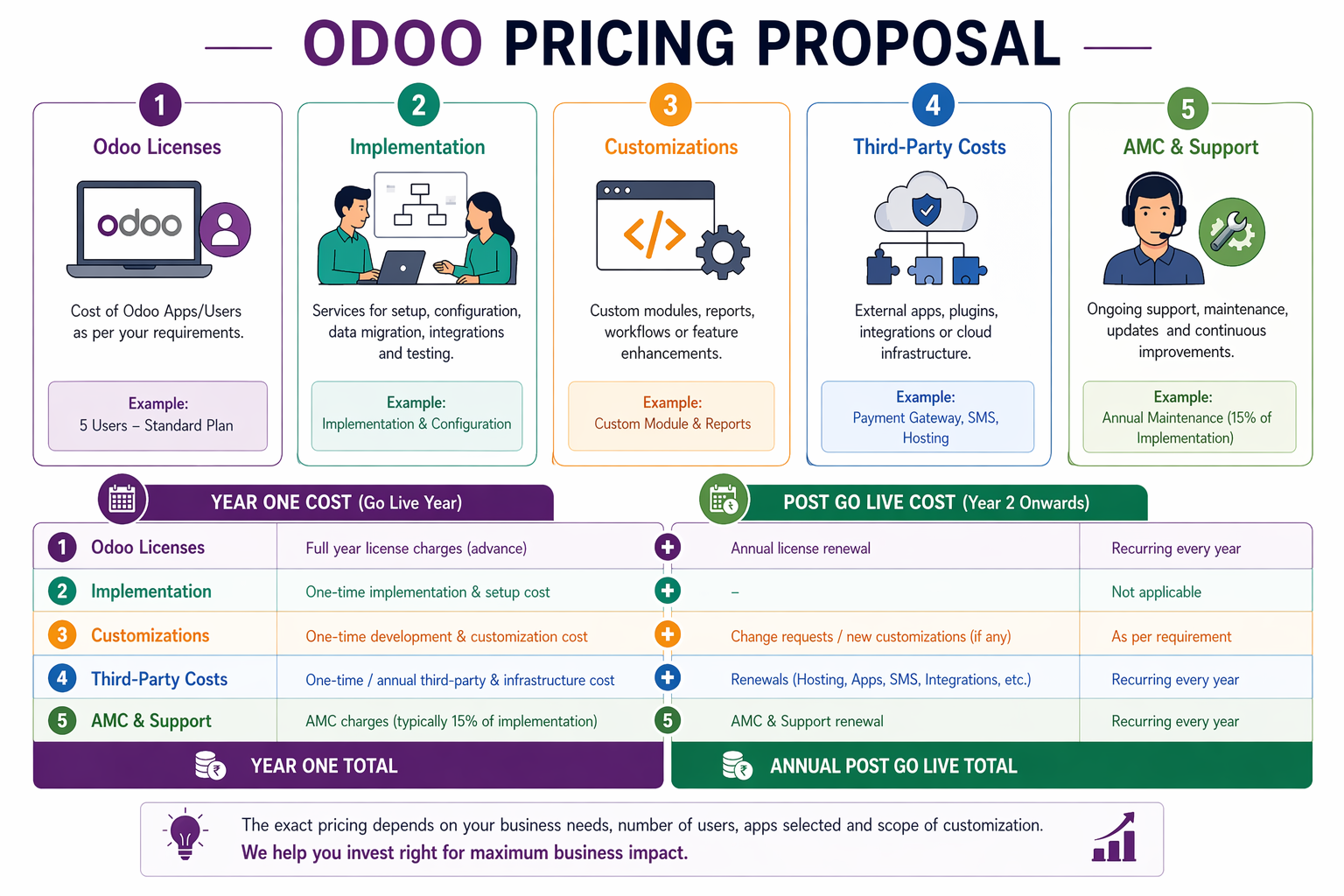
Every Odoo Pricing proposal contains five distinct cost components. Transparent partners list all five clearly. Many do not. Here is what each covers and exactly what to ask before you commit.
-
→
1. Licence cost The per user monthly fee for Odoo Enterprise, or zero for Community. Ask whether the first year promotional rate is factored in and what the full rate looks like in year two. See our detailed Odoo Pricing guide for current India rates and edition comparisons.
-
→
2. Implementation cost The largest variable in any proposal and the one that varies most between partners. Ask whether this is fixed scope or time and material. Fixed scope means you pay what is quoted regardless of hours taken, while time and material means scope creep becomes your cost.
-
→
3. Data migration cost Frequently listed as "subject to data quality" or excluded from the proposal entirely. Ask whether data migration is in scope. If not, request a separate estimate and clarify who absorbs cost overruns if your legacy data needs cleaning before import.
-
→
4. Customisation cost Listed as an estimate in most proposals, not a fixed number. Ask what the change request process is and what the per developer hour rate is for changes beyond original scope. A well scoped customisation contract should have this documented upfront.
-
→
5. Support and AMC Frequently missing from year one proposals entirely and introduced only after go live when you are most dependent on your partner. Ask what happens after go live and whether there is a written SLA with a guaranteed response time.
⚠️ Watch out. If a proposal lists implementation cost as a single line item with no module breakdown and no exclusions list, ask for a detailed scope document before you sign. Ambiguous scope is the single biggest driver of implementation disputes.
Costs That Surface After Go Live
These are not surprise costs. They are predictable software lifecycle expenses that standard proposals rarely itemise. Every one of them can be planned for if you know to ask about them before signing.
-
→
Version upgrade costs Each major Odoo release is a migration event where custom modules need porting, data structures may change, and testing takes developer time. Expect INR 1 to 5 lakh per upgrade depending on customisation depth. See our Odoo version upgrade breakdown for what this involves end to end.
-
→
Third party module repurchases Odoo App Store modules are typically licensed per version. If you are on Odoo 16 and upgrade to 18, most paid modules need to be repurchased or renegotiated. Clarify this with your partner at the proposal stage, not after upgrade scoping begins.
-
→
Scope creep in customisation Small change requests after go live accumulate faster than most buyers expect. Budget an additional 15 to 30 percent above your implementation quote for post go live adjustments in year one, especially if your workflows are complex.
-
→
Department specific training Initial training covers core users at go live. New staff onboarding, department level workflow training, and admin handover sessions are rarely included in the base scope. Ask exactly how many training hours are in scope and what additional hours cost.
-
→
Internal project management time Someone at your company owns the implementation internally, covering requirements review, UAT testing, and department coordination. That person's time is a real cost even if it never appears on an invoice. Factor it in when comparing implementation quotes.
Odoo Community vs Enterprise and What Indian SMBs Actually Pay
For Indian SMBs, the Community vs Enterprise decision is ultimately a resourcing question, not a features question. Here is the honest breakdown.
Odoo Community is free to license but requires internal technical capacity to maintain. For a 15 user Indian SMB without an in house IT team, Odoo Enterprise with a certified partner typically delivers lower three year total cost of ownership than Community with recurring break fix developer engagements.
← Scroll to see all columns →
| Feature | Community | Enterprise |
|---|---|---|
| Licence cost | Free | ~INR 725/user/month |
| Hosting | Self managed server | Odoo.sh or partner hosted |
| eCommerce and payroll | ✗ | ✓ |
| Official Odoo support | Community forums only | ✓ Included |
| Version upgrade path | Manual, managed by your team or partner | Assisted migration path |
| Best suited for | Businesses with in house IT team | SMBs without dedicated IT |
Typical year one cost for a 15 user Enterprise deployment in India
| Enterprise licence (15 users, 12 months) | ~INR 1.3 lakh |
| Implementation (scope dependent) | INR 3 to 8 lakh |
| Hosting | INR 60K to 1.2 lakh |
| AMC / post go live support | INR 60K to 1.5 lakh |
| Year one total | INR 5 to 12 lakh |
Community saves the licence cost entirely but transfers full system ownership to you. That means your team or a freelance developer handles every upgrade, every bug, and every security patch. For businesses with strong internal technical capacity, this is entirely workable. For most Indian SMBs, it creates ongoing dependency on ad hoc developer engagements that cost more over three years than a structured Enterprise AMC.
Seven Questions to Ask Any Odoo Partner Before Signing
A good Odoo partner answers all of these without hesitation. Take incomplete or evasive answers seriously, as they predict how disputes will be handled once the project is live.
-
01
Is this a fixed scope or time and material contract? Fixed scope protects your budget. Time and material places the cost of delays and scope changes on you. Insist on knowing which model applies before negotiating price.
-
02
What is your change request rate per developer hour? Change requests after go live are inevitable. Knowing the hourly rate before you sign means no surprises when they arrive. Indian partners typically range from INR 1,500 to INR 4,500 per hour depending on seniority.
-
03
Is post go live support included and for how long? Ask for the specific hypercare period in writing, covering how many weeks, how many hours, and what response time is guaranteed. "We are available" is not an SLA.
-
04
What does your version upgrade process look like and what does it cost? A partner who has run upgrades before can give you a realistic estimate and a clear process. One who hesitates or gives you a vague answer likely has not done many.
-
05
Is data migration included or separately scoped? Ask for a data migration assessment before the proposal is finalised, not after. If your legacy data is in poor shape, that cost can equal or exceed the implementation itself.
-
06
Have you implemented Odoo for businesses in my industry and can I speak to one of them? Industry specific experience reduces your implementation risk significantly. A reference call with a similar client is the single most useful due diligence step you can take before signing.
-
07
What are the payment milestones and are they tied to deliverables? Payment schedules should track delivery stages such as requirements sign off, UAT completion, and go live. A proposal that is heavily front loaded, asking for 60 to 70 percent upfront, shifts all project risk to you.
What a Transparent Odoo Pricing Proposal Should Include
A well structured proposal removes ambiguity before the project starts. If a partner's proposal is missing more than two of these, ask why before you sign. You can also run a quick Odoo ERP support audit against your existing system before committing to a new implementation.
- ✓Fixed scope with a clearly documented list of modules and explicit exclusions
- ✓Separate line items for licence, implementation, data migration, training, and support with no single bundled number
- ✓A post go live support plan with a defined SLA covering response time, support hours, and escalation path, all in writing
- ✓Version upgrade policy documented with details on who owns the work, what the estimated cost is, and how the process is managed
- ✓Payment milestones tied to delivery stages and not front loaded lump sums that shift all risk to the buyer
- ✓AMC options presented upfront with clear pricing and not introduced as an afterthought once the system is live and you are dependent on your partner
How Tatvamasi Labs Scopes Every Proposal
We are a certified Odoo Silver/Gold Partner based in Ahmedabad. Every proposal we issue follows the same structure because we have seen what ambiguous proposals cost clients in disputes, delays, and scope arguments.
- ✓Fixed scope implementation with a documented module list and explicit exclusions before sign off
- ✓Separate data migration assessment completed before the proposal is finalised and not estimated after the project starts
- ✓Post go live hypercare period defined in writing, covering timeline, scope, and response SLA
- ✓AMC options presented with the proposal and not after you are live and dependent on our team
- ✓Reference clients available on request in your industry, including manufacturing, distribution, eCommerce, solar, and field service
In our experience across 80+ Odoo projects, the proposals that cause the most post implementation friction are the ones that looked cheapest at signing. A clear, detailed proposal costs nothing extra to write and it saves both sides a significant amount of time and money once work begins.
Get a fully scoped Odoo proposal with no ambiguous line items
We scope data migration before pricing it, and present AMC options at proposal stage and not after go live.
Frequently Asked Questions
Prefer a quick chat? WhatsApp our team and we respond within the hour.
💬 Chat on WhatsApp