



From fragmented operations to a unified platform — reducing dispatch cycles, automating warranty management, and driving a 14% increase in lead-to-order conversion via Odoo based ERP solution.
Client Snapshot
| Client | Qbits |
| Industry | Solar Inverter Manufacturing & Renewable Energy |
| Headquarters | Surat, Gujarat, India |
| Presence | Pan-India with global distribution |
| Team Size | 100–150 employees |
| Product Portfolio | On Grid Solar Inverters |
| Platform | Odoo ERP (customised for inverter manufacturing) |
Introduction
India's solar energy sector is at an inflection point. With the government's ambitious target of 500 GW of renewable energy capacity by 2030, solar inverter manufacturers sit at the heart of the energy transition. For companies like Qbits, this growth is both an opportunity and an operational stress test.
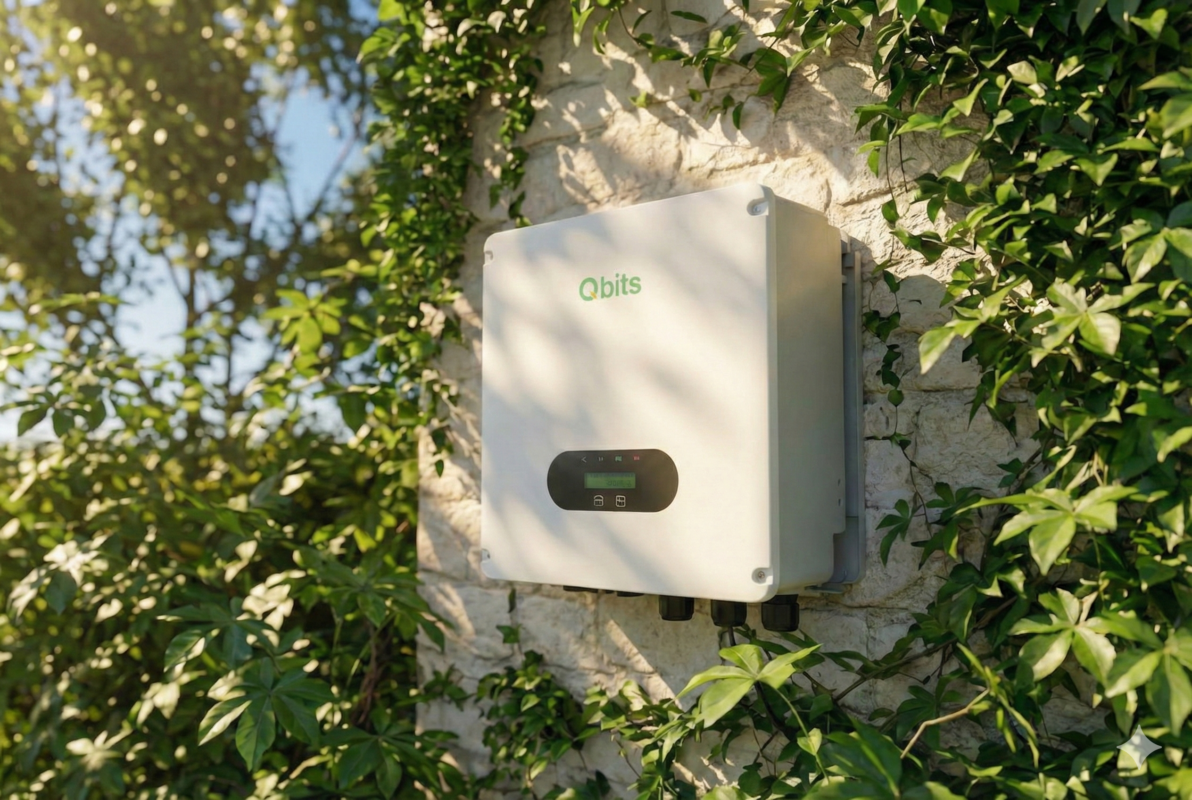
Qbits is one of India's emerging names in solar inverter manufacturing, supplying high-performance string and hybrid inverters to utility-scale solar farms, commercial rooftop installations, and industrial facilities — both domestically and across international markets. Their product line carries a minimum 12-year warranty, a badge of quality that also translates into decades of post-sales obligation.
As Qbits scaled from a niche player to a mid-sized enterprise, the operational backbone that had worked at 50 people simply couldn't support a team of 150 or a customer base spanning continents. Disconnected spreadsheets, manual warranty certificates, and siloed lead management had become not just inefficiencies — they were active business risks. The need for a purpose-built inverter ERP was no longer optional.
The Challenge: Growing Pains Across Every Business Cycle
Qbits operates across a complex web of interlocking business cycles: purchase-to-pay (P2P), order-to-cash (O2C), plan-to-produce, and a long tail of after-sales service obligation. Each of these cycles had its own set of problems — and none of them were talking to each other.
🔁 Purchase-to-Pay (P2P)
Procurement & Inventory
- ✗No visibility into landed costs, customs duties, or supplier lead times
- ✗Reactive inventory with no forward demand signals; frequent overstocking and stockouts
- ✗No clear picture of margin by product, geography, or channel
💰 Order-to-Cash (O2C)
Sales & Revenue
- ✗Leads from portals, website, exhibitions, and referrals arriving with no unified routing
- ✗Production, procurement, and logistics not connected; no order visibility for sales teams
- ✗High-value accounts lost due to slow response and lack of order tracking
🛡️ Warranty Management
Post-Sales Obligation
- ✗Every certificate created by hand — error-prone and time-consuming at scale
- ✗Warranty validation required manual search across Excel files
- ✗Poorly documented records creating legal and financial exposure
🔧 Operations & Maintenance (O&M)
Field Service
- ✗Scheduling via calls and WhatsApp; no SLA tracking or spare parts visibility
- ✗No automated touchpoints; experience dependent on individuals, not process
The Solution: Odoo ERP, Customised for Solar Inverter Manufacturing
The engagement began with a discovery phase — mapping every business process from a purchase enquiry through to a warranty claim. What emerged was a clear blueprint for an Odoo ERP implementation tailored to the specific operational reality of a mid-sized inverter manufacturer. Rather than forcing Qbits into a generic setup, the platform was shaped around how a solar inverter business actually works — with deep Odoo customization across warranty management, manufacturing planning, and the sales cycle.
Centralised Lead Management with Intelligent Routing
All lead sources — website contact forms, B2B portals like IndiaMART and TradeIndia, trade show scanners, referral registrations, and direct calls — were integrated into a single CRM pipeline within Odoo. Automated routing rules directed each lead to the appropriate regional sales manager based on geography, project size, and product type.
Duplicate detection eliminated the embarrassment of multiple salespeople chasing the same account. Follow-up tasks were auto-assigned with SLA timers, ensuring no enquiry went cold. The entire sales funnel — from first enquiry to quotation approval — became visible to management in real time.
Integrated O2C: Inquiry to Dispatch in One Platform
Once a quotation converted to a confirmed purchase order, the Odoo ERP automatically triggered a production work order, updated the material requirements plan, and notified the warehouse team to reserve stock. Sales coordinators could now track order status without calling the production floor. Dispatch teams received automated pick-list notifications.
📦 Dispatch cycle compressed: What previously took 18–22 working days was reduced to 11–13 days — not by adding headcount, but by eliminating idle time between handoffs.
Automated Warranty Certificate Generation
One of the most impactful Odoo customizations in the entire project was warranty certificate automation. Upon dispatch confirmation, the system automatically generated a personalised warranty certificate — branded, populated with the inverter's serial number, model, installation site, and warranty expiry date — and delivered it to the customer and channel partner via email, with a copy archived in the system.
What previously required significant manual effort in data entry and document formatting was reduced to zero. The team members who had been managing this were redeployed to higher-value customer success and technical support functions.
Warranty Lifecycle Management
Every installed unit now has a complete digital lifecycle record within the solar inverter ERP — from the bill of materials used in manufacturing through to the full warranty claim history. When a claim is raised, the system validates it in seconds: serial number lookup, installation date verification, warranty status check, and automatic claim ticket creation.
Service engineers receive structured job cards with all relevant product information before arriving on site. Spare parts consumption is tracked against each claim, creating a feedback loop that has already helped Qbits' engineering team identify recurring component failure patterns addressed in subsequent production batches.
Finance: Profit Centre Intelligence Across Products and Geographies
The Odoo finance module introduced profit centre accounting that gave Qbits' management team a view they had never had before: margin by product line, revenue by geography, and channel-level profitability. For the first time, leadership could answer — Which inverter model should we prioritise? Is our international distribution business actually profitable after accounting for warranty costs?
Purchase-to-Pay automation connected supplier invoices directly to GRNs, eliminating the month-end reconciliation marathon. Three-way matching (PO, GRN, Invoice) became a system function rather than a finance team exercise.
Smart Manufacturing Planning with Import Awareness
The Odoo manufacturing module was configured with Qbits' import dependency at its core. Material Requirements Planning (MRP) runs account for supplier lead times, port transit times, and customs clearance buffers — flagging potential production shortfalls weeks before they become crises.
Sales forecasts now feed directly into the production plan, which in turn drives purchase requisitions. The warehouse team went from reactive stock management to a forward-looking model with four to six weeks of component visibility. Warehouse space utilisation improved, and the carrying cost of excess inventory dropped materially.
O&M Team Optimisation
The Odoo field service module brought structure to what had previously been an informal operation. Preventive maintenance schedules are system-driven, with automated reminders sent to both customers and field engineers. Service calls are logged, prioritised by SLA, and dispatched to the nearest available engineer.
💡 Notable outcome: Despite Qbits' installed base expanding by approximately 35% during the implementation period, the O&M and dispatch team headcount was reduced by 30% through role consolidation — while customer response times actually improved.
Results: Measurable Impact Across Every Function
Across every function — sales, operations, finance, and after-sales — the impact of moving to a unified Odoo ERP for solar inverter manufacturing was significant and measurable.
| Metric | Result |
|---|---|
| Lead-to-Order Conversion Rate | +14% within two quarters of go-live |
| Inquiry-to-Dispatch Cycle Time | Reduced from 18–22 days to 11–13 days (~40% faster) |
| O&M and Dispatch Headcount | Reduced by 30% while handling a larger installed base |
| Warranty Certificate Processing | Fully automated — zero manual errors since go-live |
| Warranty Claim Resolution Time | From ~2 hours (manual) to under 3 minutes |
| Inventory Carrying Cost | ~22% improvement in warehouse utilisation |
| Finance Visibility | First-ever profit centre reporting by product, channel, geography |
| Sales Planning Accuracy | 4–6 weeks forward demand visibility vs. reactive weekly firefighting |
These outcomes weren't the result of hiring more people — they were the direct result of Odoo customization that aligned the platform with Qbits' real-world workflows rather than forcing the business to adapt to a generic tool.
We always knew our operations needed to be tighter, but we didn't realise how much revenue we were losing until we could actually see the lead pipeline in one place. The warranty automation alone paid for itself within the first six months. We finally have the foundation to scale to the next level.
Why This Matters for Solar Inverter Manufacturers in India
The solar inverter industry in India is entering a phase of consolidation. Tier-1 manufacturers with strong operational infrastructure will capture an outsized share of the large-scale utility and commercial projects that define the next decade of renewable energy growth. Tier-2 and Tier-3 players that continue to operate on spreadsheets and fragmented tools will struggle to meet the reporting, traceability, and service-level expectations of sophisticated EPC clients and institutional buyers.
Qbits' investment in an inverter ERP was not just an operational upgrade — it was a strategic decision to build the infrastructure of a scalable, auditable, and credible enterprise. The ability to provide instant warranty validation, accurate production ETAs, and clean financial reporting is increasingly a qualification criterion in large B2B solar tenders.
For manufacturers evaluating Odoo ERP for solar or similar platforms, Qbits is proof that the right implementation — with deep Odoo customization built around industry-specific workflows — delivers returns well beyond standard out-of-the-box deployments.
As the broader solar ecosystem in India matures — with more stringent MNRE compliance requirements, increasing scrutiny on ALMM-listed manufacturers, and the growing importance of export markets in Southeast Asia and Africa — companies that have invested in robust solar ERP platforms will be structurally better positioned than those that have not.
Key Odoo Modules Deployed
| Module | Primary Benefit |
|---|---|
| CRM | Single-source pipeline, auto-routing, SLA tracking |
| Sales & Order Management | Inquiry to dispatch in one workflow |
| Warranty Management (Custom) | Automated certs, lifecycle tracking, claim validation |
| Manufacturing & MRP | Import-aware scheduling, demand-driven production |
| Odoo Inventory & Warehouse | Forward visibility, reduced carrying cost |
| Accounting & Finance | Profit centre reporting by product, channel, geography |
| Purchase (P2P) | 3-way matching, supplier performance, cost tracking |
| Field Service | SLA-driven scheduling, engineer dispatch, spare parts |
Conclusion
Qbits' transformation is a case study in what becomes possible when the right Odoo ERP implementation meets a business ready to scale. The company did not need more people — it needed better systems. A centralised solar inverter ERP eliminated the coordination overhead that was silently consuming capacity, introduced the financial intelligence needed for smarter decisions, and created a customer experience foundation strong enough to support Qbits' next phase of growth.
For solar inverter manufacturers navigating the complexity of import-dependent manufacturing, long-tail warranty obligations, and increasingly sophisticated B2B buyers, the message from Qbits is clear: the time to build enterprise-grade operations is before scale demands it — not after. And for businesses in India's renewable energy space, Odoo customization done right is one of the fastest paths to getting there.
Ready to transform your solar inverter operations with Odoo ERP?
Speak to our renewable expert about an implementation tailored for renewable energy industry.
Prefer a quick chat? WhatsApp our expert — we respond within the hour.
💬 Chat on WhatsApp